Author Archives: susan

I’m cool like that

Turns out watching Jon Stewart’s Daily Show is a contradiction in personality terms. Who knew.

Last week I read that I’m cool – apparently, according to the Globe and Mail’s TV columnist, Conan O’Brien’s move to cable was a brilliant tactical move because only stodgy middle aged people watch Leno and Letterman at 11 on whatever networks they’re on; the truly edgy folk (such as yours truly) watch Jon Stewart on cable.

This explains why I keep having these urges to shave my head and make up rap lyrics.

Then again, I can’t understand why anybody would ever watch the two L’s – wherever they were. Never seemed like a good notion to me to watch creepy guys telling recycled, antediluvian jokes that weren’t funny when Henny Youngman told them, particularly as you’re getting ready to go to sleep. Bound to give you bad dreams.

Then, tonight, I found out – on Jon Stewart naturally – that according to Fox News’s Bernie Goldberg (Bernie Goldberg?!  What kind of name is that for a person on Fox, I ask you) Stewart is merely pandering to his small, “unsophisticated” cable audience (when he points out some of Fox News’s’ idiocies and contradictions).  All in patronizing tones that made me want to hit him – particularly when he seemed to take umbrage at Jon Stewart actually being polite to his guests, even when he disagreed with them. Wow. What a concept. Politeness. Obviously one Fox is unaware of.

So there you have it. According to Fox,  only unsophisticated people watch Jon Stewart.

Now I’ve been called a lot of things – cranky, curmudgeonly, stubborn, irritating, even childish and idiotic – but unsophisticated? Please. I’m sophisticated enough to recognize a gentleman when I see him and Mr. Stewart is a gentleman. And clearly a very nice man.

We don’t get the Fox News Network in Canada which is just as well. Even flicking past it would probably make me apoplectic. It seems to embody the absolute worst of this experiment they call America: boorish, xenophobic, crude, partisan and – let’s not mince words – stupid. The snippets I’ve seen on the Daily Show and the first segment of Colbert make me shudder and do not bode well for the future of the American republic. Particularly since Fox is the fastest-growing network in the U.S.

That’s even scarier than Letterman’s face, frankly. (Since that poor man had quadruple bypass surgery he looks like a zombie walking). Someone should have told him that a massive heart surgery is not “preventive” of anything, particularly dying of heart disease.

But back to Fox. I guess they’re trying to prepare America for the challenges of the 19th century.

My  impression of Goldberg and Glen Back and Sarah Palin and the Tea Party movement they’ve spawned is of a sad, scared group of people who are so terrified of Obama and any change – even if it means an improvement to what’s been – that they will literally cut off a nose to spite a face. Who seem to think the fifties were some kind of Xanadu. When men were men and women were women and little green men were little green men from Mars.

It was a time when America was #1 (because Europe was still rebuilding after the second world war) and in many ways the idea of America was amazing.  As a Paris cab driver once wistfully said to me, when he was a child in the sixties, America was jazz and cowboys, civil rights and the space program, walking on the moon. It was science and innovation, Hollywood and glamour.  American was cool. No more.

Now, it’s Goldman Sachs and Wall Street, wars in Iraq and Afghanistan, Walmart and kids’ toys made in China contaminated with lead (because nobody’s willing to pay more than $5 for anything).

It’s a pity the folks at Fox haven’t twigged to the fact that things have changed and being unpleasant ends up working against the America they profess to love. In any event, change, no matter what they think about it, simply happens. It doesn’t care. Seasons change, babies grow and later grow old and die.  We change. Things evolve; true, not always for what you or I might consider as the “best”, but hey, that’s life. Life is change.

Screaming just makes you hoarse. And rudeness and spite, as Robespierre found out, only begets more anger and sometimes that guillotine you’ve built to get your enemies with ends up getting you. Fox should perhaps be careful what it wishes for – it might not like the result.

But hey,  I’m cool with that.

ObamaCare – damning with faint praise all one can do

Two weeks ago President Obama signed what is being called an “historic” health care bill, and belated the United States is to have a sort-of-almost-maybe national health care system. Except that much like the Holy Roman Empire, which was neither Roman, holy nor an empire, US health care will not be universal (some fifteen million people are still left out in the cold), national (people still have to buy health insurance) or particularly historic, since everybody else in the western world got health care 40+ years ago. So, er, hurray.

comme-ci, comme-ca health care*

Of course everybody hates it.

The left because they maintain, not unreasonably, that Obama gave up the public option (early on he seemed to be harbouring the vain hope that it would lead to some bipartisan support) and as such Medicare, the existing system for seniors, was not expanded – which would have at least provided a kind of national health care without starting from scratch. Pity. That would have been the logical route. But nooo. Not in America. So, the basic, dysfunctional structure of American health care remains – and insurance continues to stand firmly between the patient and the health care provider.

The right hates it more and for a lot more reasons – although there’s some serious irony here since the genesis of this bill was the Republican proposal to counter what was dubbed HillaryCare back in the 90’s.

First and foremost, the right is cranky because a lot of them listen to Glenn Beck and Fox News and hang out at those tea parties where there aren’t any sandwiches, and they simply hate anything Obama does. More rationally, however, they object to the form of the bill, which forces individuals to purchase health insurance (which, if they can’t afford, the government will subsidize). Here they have a point, since you have to admit it does seem a touch undemocratic to make people buy something whether they want to or not.

Republicans add that the the bill makes no attempt to cut costs or deal with the ludicrous consequences of  litigation; this argument is true albeit disingenuous since if they had actually got involved, as Obama had asked, they could have added that in.

Business is not too keen on this bill either, probably because health insurance is currently provided, for the people who have it, through their employer, and business has no idea what this bill implies for them, and they loathe uncertainty.

(The bill would tie health insurance to the person, so even if they lose their job they keep their insurance. There is also talk of creating some kind of risk ‘pooling’ for people who are not employees but self employed or what-have-you. Plus, in theory at least, insurance companies will no longer be allowed to turn away people with pre-existing conditions – though I’m sure some clever lawyers are already figuring out other ways to reject people they think will cost too much. Too tall, perhaps or too freckled.)

My problem with this bill is its fundamental premise, namely that health care has to be administered by insurance companies. It’s a nincompoop idea and only one that a country besotted with business could endorse.

Insurance companies, boys and girls, are what are known as bu-si-nesses. This means that they exist to  make money: their raison d’etre is profit. If it were otherwise we’d call them, oh, NGO’s. Not-for-profits. (That’s what we used to call charities before we opted for the more unwieldy name.) Except that health care, medicine, is not and cannot be (ever!) a business. Economists long ago realized that it simply does not fit the market model.

Health care is not a commodity. You cannot make money on health care. Never mind that you shouldn’t. Why? Well, for those of you who missed Econ 101, I’ll explain. Please pay attention, there’ll be a quiz later.

The free market is at heart transactional: I make hand-embroidered doilies; you, for reasons that elude everyone else, like and want hand-embroidered doilies. So, I make them and you buy them from me. And we’re all happy. I, in turn, use the money I make to buy things I want/need, like food and shelter and some really cool stilettos. Supply and demand.

But (and here’s where it gets tricky), if a villager in China can make aforesaid doilies that are just as nice for a lot less, then you will get them from her so I will be out of business, unless I move my manufacturing to an even cheaper place, Bangladesh, say. This, in a nutshell, is the free market, which, in Adam Smith’s immortal baker metaphor, does not rely on the goodness of anyone’s heart but is inherently rational. As are consumers.

Now you and I both know that this is patent nonsense. Not only are most people not rational consumers, most of the time they  are crazy. Or, as a psychiatrist would say, stark raving bonkers. Why else would tens of thousands of people line up on Boxing Day to get a gizmo they don’t need? Or pay good money to buy a piece of bacon wrapped in a pancake with a list of ingredients too long to read? (I could go on but you get the picture.)

Even if consumers aren’t nuts their actions are often dictated by a lot of things other than reason, price and need. Otherwise nobody would ever buy a Kelly bag or have eighteen pairs of virtually identical black trousers. But for the sake of argument, let’s stick to the model – this is 101, remember, and we don’t have time to veer into behaviorial economics and all that complicated stuff like status and advertising and whatnot.

So homo economicus operates on simple efficiency and if he or she can afford it, they will get the best darn doily or car or house they can get. So, people with money get the nice stuff, the cashmere sweaters and the Prada belts, while everybody else makes do with Joe Fresh and H&M. That’s life according to economics.

Health care doesn’t work that way. Nobody gives up a trip to the Bahamas to check themselves into the hospital for a quadruple bypass for fun. That’s because, in economics-speak, health care is not a direct “purchase” but is subject to agency issues. In other words, there is a person or a group between the person and whatever is being bought, whether it’s a bypass or a prescription. When I feel sick, no matter how many internet sites I surf or friends I text, I really don’t know the reason; I need a doctor. Or a nurse. Or a faith healer if that’s what I happen to believe in. Even if I did figure it out the diagnosis, I can’t write myself a prescription or do surgery on myself. I need someone else, an “agent”, to confirm my choice. (In terms of that quadruple bypass I should really go back to the internet and do some serious research because there’s no evidence it is in any way preventive if I’m feeling all right, but that’s another post.)

Medicine, unlike cars and refrigerators and new tiles for the bathroom, is about a patient, a person who is sick and vulnerable and scared and in no position to make rational choices about anything. This is also why there are medical ethics and professional organizations and the Hippocratic Oath (though that’s just a metaphor, the actual Oath hasn’t been used for nearly a century no matter what TV shows would have you think.)

“Enough”, when it comes to cars and refrigerators and trips to sunny Spain is only limited by your budget and, presumably, greed and appetite: if you really want thirty six SUV’s, or feel the need to stuff your kitchen with 97 Sub-Zero fridges full of chocolate ice cream and would like to give Imelda Marcos a run for her money when it comes to shoes – well, if you can afford it, it’s your choice. Medicine is not like that.

Too much medicine – too many medical interventions – can kill you.

It’s called iatrogenesis. A term from the Greek, meaning harm caused by medical treatment. One aspirin can take away your headache; popping the whole bottle is a suicide attempt. One operation could save your life (if it goes well) but if you have an appendectomy and for whatever reason things screw up and you end up in ICU with sepsis and need four more operations, well, you could easily end up maimed or dead. In fact the more you get done medically, the lower your chances.

As Peter Davis writes in the Canadian Medical Association Journal (“Health Care as a Risk Factor”, http://www.cmaj.ca/cgi/content/full/170/11/1688), close to 70,000 preventable adverse effects occur each year, some 20% of which result in the person’s death. This, writes Davis, is not because hospitals are inherently dangerous places but because the “unchallenged therapeutic imperative” tends to move people to ever-higher (and more complex) levels of care, levels that they are unable to sustain.

When people proudly proclaim that American health is “the best in the world” therefore, as they are wont to do, what they mean is that they have access to more MRI’s and operating theatres and doctors than anyone else. The model they’re using is that of the market. Except they’re dead wrong (so to speak). By any objective measure American health care is the worst in the developed world. Life expectancy is lower, infant mortality is higher and your odds of surviving healthily after a heart attack are considerably lower than they are anywhere else in the west. Why? Iatrogenesis. Americans do too much. Too many tests, too many surgeries; too many drugs. In short, overtreatment. Because medicine in the US is treated like a commodity, like cars and refrigerators and Prada bags, which it is not.

That’s what Obama’s bill didn’t even begin to address. True, some of the currently uninsured might, if  all goes well, not end up bankrupt if they get sick. More people will have access to health care. The notion that health care might be a basic mark of a civilized society has at least come up and might even be discussed further. It will continue to cost too much (16% of GDP at last count versus an average of 10% in Canada and France and everywhere else); doctors will continue to practice “defensive” medicine and Americans will continue to get sub-standard care. But at least it is a start.

Too bad it was so fitful.

* photo c/o creative commons and newsrealblog.com

Entropy and economics

Entropy. It means disorder, more or less, and refers to the tendency that all things in the universe have  to gradually lose coherence. To fall apart.

The term comes from thermodynamics – heat and work – and explains, with blinding simplicity, howeven the most efficient of closed systems will lose energy and become less efficient with time. So be it a steam engine (which Nicolas Carnot, one of the early 19th century thinkers in thermodynamics, used) or a plane, bird or Superman, its inevitable fate (at least if it’s not a fictional superhero) is to fall apart. Or, in the immortal words of my adored Flanders and Swann: “Heat is work and work’s a curse; and all the heat in the universe is gonna coooool down. That’s entropy, man.”

That’s why airplanes are painstakingly taken apart and greased, fixed and rejiggered so they don’t fall apart when we’re flying on that cheap flight to Tahiti; it’s the reason  cars and refrigerators and everything else eventually end up in landfills. And it’s why pristine comics or teddy bears or whatnot are worth a fortune: there’s not a lot of them about.

But we’ve forgotten about entropy; the term is barely used. I remember it from a 70’s era Isaac Asimov short story which gives you an idea of long ago it even touched popular culture. No, we like to think of ourselves as having imposed a lasting order – not least because of our clever algorithms and chic equations.

Take this economic crisis we’ve created. At its epicentre was the belief that markets are knowable, rational, explain-able. Of course even a  child who’s tried to trade a baseball card knows this makes no sodding sense, but greed and hubris and a lot of money all came together at once and people really came to believe that this time it was different.  What went up wasn’t going to come down.

After all, there were these equations ….

Turns out some really clever people came up with some algorithms that seemed to work for a time. So, like all greedy eejits they believed their own press clippings (not to mention the fat bonuses) and soon all of Wall Street and much of London and Zurich and the rest followed suit, rolling the dice convinced that it wasn’t luck but science. Hey, everybody loves it when things that seemed unpredictable and unknowable can be reduced down to a quantitative model – probably because so few of us actually understand any of the math. So the “quants” (for “quantitative”) directed the finance industry towards the Kool Aid. Now of course, there’s analysis and backtracking and people who knew it was going to happen (see http://tgam.ca/LIF via @globeandmail for a review of a book on the subject) but really what happened is that people wanted to believe  they understood how it all worked.

Why else would otherwise quite clever people set aside all rationality to invest in acronyms they didn’t understand? And it is a comforting notion, that markets are über-rational and what had always seemed random could be reduced down to a handful of equations. So, staggering sums of money ended up in chopped up pieces of debt,  mortgages, and then it all came tumbling down. (Of course at every step of the way a hefty commission was being pocketed so it was to many people’s advantage not to rock the boat, whatever their private beliefs in the rationality of markets.)

What these “too big to fail” banks and funds forgot was that expressing anything in quantitative terms requires thought, not computers; you have to understand,  in depth, what that equation fundamentally means. And all its ramifications. One of the most seemingly simple equations – E = mc2 – occupied Einstein his entire life. D’you think he was just slow? Or that with computers he’d have managed it in a weekend?

The universe just doesn’t give a damn. Civilization, progress, is just our feeble attempt to thwart entropy.

“My name is Ozymandias, King of Kings …. Look on my works ye mighty and despair .. “

But here we all are, in spite of it all still bright-eyed and bushy tailed, convinced we’re so much cleverer that all those silly oafs who came before (including Boyle and Carnot and Nernst and all those other clever johnnies who actually managed to came up with thermodynamics). After all, we have Google Earth and iPads and we’re good at expressing ideas numerically. Unfortunately, no matter how much we like things to be neat and fit into those cool spread sheet boxes; no matter how much we’d like to think our rules, our ideas, are those of the universe, real rules are few and far between and almost never apply across the board to all situations.

But we don’t believe that, so we don’t agonize about the moral dimensions of our economic theories as Adam Smith did or stop to wonder if our exuberance might be irrational. No, we actually think that what we’ve come up with – our rules and theorems and guidelines and ideas and metaphors; the narratives we’ve constructed to explain how markets work (efficiently), or how physiology might function (neatly, mechanistically) or biology operates (hierarchically) – are real.

As the geneticist Richard Lewontin writes in The Doctrine of DNA: Biology as Ideology (HarperPerennial, 1992) writes, we’ve succumbed to the delusion that our metaphors and narratives exist. So often have we heard our genes described as the “blueprint” of life that we have come to believe biology is destiny. So often have we heard mechanistic metaphors used to describe our organs that we believe replacing a defective heart is akin to changing the engine on an aging Camaro. So ubiquitous is our reverence for our own cleverness that we forget previous generations thought they had it right too.

Memories are short these days and we forgot. Forgot that whether it’s finance or physiology, real life is messy.  Not quantifiable.

Viva Vancouver!

When things work out well – contrary to expectation – it is only right and proper that one acknowledge this. And, as it turns out, the Olympics (whatever the long-term consequences might be) appear to have been a stellar experience.  People even less enthused about them than I (whose interest, to quote Edward Lear, would have had to grow to be even cursory) have told me that the energy was positive, the vibe, good and the atmosphere good-natured: in short, the whole experience was simply splendid.  For whatever reason, these 2010 Winter  Olympics brought out the best in people, visitors and residents alike.

So all in all A Good Thing – and now that the 2010 Winter Olympic and ParaOlympic Games are over, closing ceremonies and fireworks finished, one can breathe a sigh of relief and say: Bravo Vancouver!

Inevitably, a handful of people have taken this wonderful memory way, way too far – at least according to what I read. These folk are said to be “grieving” the end of this huge party, this wonderful feeling of liberation, this sense that Vancouver was a real city, united and at one with the universe. Ah, get over it. Parties end, everybody goes home, the mess has to be cleaned up.

I’ll wager the many small businesses who did zero business during the Olympics aren’t that sorry to seen the end of it, no matter how much as individuals they may have liked dancing in the streets. (A merchant at Granville Island, a hub for many pavilions and events, told me that “unless you sold fast food or booze you didn’t sell anything”.) Perhaps that is why, pleased as I am that it all went well, that I am glad (nay, ecstatic) that I left the city and that it’s bloody over.

My impression is that festivities tended towards youthful exuberance and the beer-fuelled; my proclivities tend more towards red wine and quiet jazz. A friend who wrote an Olympic Diary to record the wonderful time she and her husband had relates that they stood in line for nearly three hours to get into some pavilion or t’other – and frankly, I wouldn’t stand in line that long to meet the late JC .

I don’t see the point of wandering the streets, no matter how charming the crowd or super-cool the win – which that Canada-US hockey final turned out to be.

And the crowds go wild when Canada wins hockey gold

Even the massive police presence felt benign, protective, apparently. There were a few hiccups at the start, particularly the second day when some scary looking ski-masked thugs broke windows at the Bay downtown and the police looked really jittery. But things settled down – and the massive crowds felt like a large, happy family.  Another friend, about as enthused as I was at the outset, told me he found himself (much to his own astonishment) high-fiving a large, mildly sossled,  American gent partying downtown and this uncharacteristic gesture actually felt right.  OK, that’s impressive.

Perhaps it was all that international attention, the bulk of it positive.  This I noticed on my travels; people really seemed psyched about Vancouver and not just the gorgeous scenery, although that did garner much attention. The mountains! The water! The forests! Si beau! And wasn’t I lucky to live in such surroundings. I smiled and mumbled something lame. One cannot, after all, take credit for nature. Still, I couldn’t help feeling a little chuffed. (I didn’t mention I live in the heart of the city and not up in the Whistler mountains.)

Most impressive was the fact that more people turned out to watch and cheer the ParaOlympian athletes than ever before, something no host city or country has done. That was elegant.

So now can we say it was all worth it? Too soon to say, really. True,  we did get a metro to the airport from downtown (though having lived a few blocks away from the construction I am still smarting from the dust and noise). And Vancouver did raise its international profile – but will that translate into actual benefits, economic or otherwise? More investment, better and more social housing, fewer homeless people, more opportunities? Possibly, but I doubt it.

In the grand scheme of things, then, did any of it matter? This short event, lasting only a few weeks, no matter how grand everyone says it was? To quote Bertrand Russell: “The fact that an opinion has been widely held is no evidence whatsoever that it is not utterly absurd.”

Well, a spot of absurdity is not the worst of things in a world where so much seems so unrelentingly dreary.  So, ephemeral as it may have been,  to everyone who was here, to the many volunteers and guides and people who worked on the Games, to the athletes and coaches and all the rest: a tip of my fedora and a red-mittened high five.

The Vancouver Olympics may not have changed the world, but they didn’t stink. A curmudgeon can’t say fairer than that.

My friend, web designer Mia Johnson, with  her daughter & gallery owner Diane Farris out there after that hockey win.

“Your opinion matters” (and low flying pigs such a nuisance)

It’s difficult to feel too curmudgeonly when one is in Paris, wandering around at exhibits and stopping for a coffee at decent intervals (usually when the last cup of coffee has caught up with one), but it seems as though the entire Occident – Paris included – is run by bureaucrats and administrators taking stupid pills. Or maybe they are simply individuals imbued with an inveterate desire to meddle, change things, fix what ain’t broke: insisting to the universe that yes, “we exist” and can make the changes to prove it.

Once upon a time here in Paris the RATP, the transit authority, had these terrific little bus maps. You could pick up a copy at the metro or wherever you got tickets; often they were on the flip side of the blindingly useful (and simple to read) metro map. Well, they are now gone. Are no more. Someone, somewhere decided they were just too useful and had to go.

Why they had to go is a mystery to me – particularly since it is not just tourists and visitors who used them; locals also occasionally made forays into unknown areas and needed a hand figuring out the best route. And this little piece of paper one could stuff in the back pocket of one’s jeans made that mega simple. But I guess today we are all supposed to use our smartphones or Blackberries or what-have-you. Never mind that reception can be spotty and batteries die and often you have to have the app for that. (And for those of us who are also “roaming” – well, we’d rather not pay any more thanks very much.)

Place St. Sulpice, Paris

So here’s my theory. Alphonse – or Jean-Phillippe or some other blighter sitting in some back office somewhere decided to muck about with a winning formula, perhaps to save on paper or printing or whatever. (And yes, I deliberately used male names because frankly I cannot believe that a woman would be such a nitwit. So it’s sexist. Sue me.) He grandly called a meeting to discuss the matter and somehow, sitting off in some conference room somewhere, it all seemed like a terrific idea. And poof! The little maps are gone. Making the front line personnel even more churlish and cranky than usual because now people are hounding them about the little maps they no longer have. (And they wonder why they go on strike.)

The problem, as I see it, is that the disappearing bus map is part of a larger trend, that of people meddling in the handful of things that actually work pretty well. Heaven knows there are enough things that don’t work – you’d think people would  have their hands full getting on figuring out how to fix those (not to mention building earthquake-proof housing in Haiti and dealing with malaria and TB in sub-Saharan Africa; hunger and human rights; girls getting an education etc. etc.). But noooo. Those are too difficult. So they turn their beady little bureaurat gaze to the handful of things that do work, the things most people like quite a lot, and decide to do away with those. Even though most of us really do appreciate thoughtful, well-designed, simple innovations like a bus map.

Corporations and institutions often talk of the exalted state of “customer loyalty” and spend much time and effort trying to figure out how to achieve it. What they seem to forget, as a friend of mine perspicaciously says, is about their loyalty to us, their customers. So, nobody consults us when a perfectly good product is “improved” (and magically costs more) even though the old version worked just fine. Nobody cares that some of  us actually used that thingamajig they’ve discontinued because too few people used it to make it cost-effective. (So raise the price a bit, already.)

Oh sure, everybody cares about our opinion and wants to know how we feel about the experience of having been crammed into that tiny airplane seat, how we liked that soggy sandwich, whether we enjoy shopping in their shiny new mall. In multiple choice form everyone wants to know how I felt about the damn experience. Unfortunately, nobody wants to know what I think.

Perhaps thinking, particularly the critical variety, is no longer fashionable – much like that bus map.

Winning at all cost seems vaguely inelegant

Sport, said George Orwell, is war minus the shooting. It brings out the worst in us: violence, jealousy and boastfulness. As I’ve watched bits of the coverage on the many screens around town (difficult to avoid no matter how hard one tries) it seems to me the only noun he missed was “irony”.

Here we are, tens upon thousands of us, queuing up to watch the athletes compete, hooting and hollering when “our” lot wins – in a manner so unseemly, if not outright rude, that it is difficult to recall what the spirit of the Olympics, and Olympians, was even supposed to be, no matter how many speeches IOC officials make.

Shouldn't we all have fun with sport?

Now to say that I’m no athlete is to understate understatement: I was one of those scrawny kids always picked last and under duress. And if the dodge or base or whatever ball ever did wend its way towards me, by that point I was usually off in my own world, “dans la lune” as my grandmother called it, and missed it (to the anguished shrieks of “Su-SAN!” from my exasperated teammates). So I am no expert on sport – well, not winning sport anyway.

Nevertheless, even I managed to find a sport (figure skating) that I could do alone, in my own time (which means slowly – I am nothing if not slow when it comes to sport). So, I figure that if I can manage to find something to enjoy, oughtn’t everyone? Particularly given that exercise and movement are two of the few things our bodies were designed to do that can actually (somewhat) help us keep healthy?

When it comes to the biggest sporting event in the world, however, I am having trouble deconstructing precisely how this incessant talk of gold and medals and winning somehow equals some kind of grand social uplift. Particularly – as a friend who is watching the coverage, points out – as any athlete beneath the top three gets zero coverage or mention. For heaven’s sake, these are athletes who made it all the way to the Olympics. Surely, even if they don’t win a medal they’re still pretty good, no?

I am nonplussed at how all this gloating too many Canadians seem to be engaged in (surely, Canada, we’re better than that?!) on how we won gold (and are so great we’ll win more, heck all the gold) constitutes “sports”manship. Or how this pageantry – for which we will end up paying, in actual money, for many years – is anything other than a very large party for a handful of people and largely meaningless, at least as it exists now, in the grand scheme of things.

Most of all, I wonder how we are glorifying sport and movement and the human body by sitting on our duffs in some stadium waving flags and hollering ourselves hoarse.

Exercise is no panacea, contrary to what the cheerleaders of the “wellness and prevention” model of health care seem to think (they always come out of the woodwork when there is any talk of altering the existing model of health care in any way); it is, nevertheless, one of the few things we can do to make a difference in our overall health. True, it won’t ward off most cancers or prevent the auto-immune disorders we tend to get as we get older – Parkinson’s, arthritis, diabetes – or matter as much as socio-economic status, but keeping fit, keeping oneself moving does bode well on many levels, both physiological and psychological.

Mastery over our own body, however miniscule (and believe me, I understand this) allows us to keep our bones strong and gives us a sense of strength and control which may well translate into feelings of autonomy in other areas of our lives, from work and career to friends and family. For women, it allows us the internal strength to open that jar or stuck window without needing to call for help and that is nothing to sneeze at. Knowing you can do things. It’s subtle and nuanced but it matters.

Even I, who always dropped the ball, know this.  I am not sure these Olympics as they have been presented do.

Flamin’ heck

I serendipitously saw the Olympic torch today.

Not what I saw but you get the picture

I was heading to an appointment; I usually take the bus but today I had some things to do (plus it was rainy and cold), so I took the car. At Oak and 25th traffic came to a dead halt – and sirens blared, lights flashed and lo and behold, a gaggle of burly motorcycle cops authoritatively slid their massive bikes into the intersection in slick, circular movements that would have done a stuntman proud. Still, I couldn’t help thinking they looked a bit like alien visitors, these police men and (presumably) women, however asexual they seemed. (And I don’t mean the warm fuzzy kind, like ALF or my favorite Martian but the creepy ones in “V” – here to conquer the planet and eat earthlings for lunch.) Maybe it was their shiny yellow rain gear or those black helmets with the visors. In fact, next to them the small group of bicycle cops looked positively cherubic.

As people got out of their cars and reached for their camera phones even I began to realize Something Was Up. And in a few minutes, there it was, the Olympic flame, carried by a pretty young woman in a white ski suit. No idea who she was but then again, I don’t know such things.

I tried to muster up some enthusiasm – it really seemed too bad of me not to be swept up by all this excitement. I think I lack the fun/pageantry gene, like most curmudgeons. Oh well, maybe one of these days one of those dandy new gene “technologies” that so far have only managed to kill people will find a cure.

But I digress. So, the torch went by and it was just terrific and all that.

Then, some 20 minutes later, as it headed off it seemed we might be able to move. Given that I was the first car in my lane, I gingerly moved forward – unsure as to whether or not I was doing the “right” thing – and, given the massive police presence, what it would mean if I did the “wrong” thing. A ticket? Handcuffs? Worse? That’s the problem when security outpaces our ability to understand or communicate its meaning; for months they’ve been telling us about various restrictions but in such general terms that (other than knowing there’s some kind of cool “central command” to coordinate security) we have no idea what any of it means.

This got me to thinking of  lecture I had watched on cable television the night before, the proceedings of some meeting or conference titled “The Right to the City: The Economics of the 2010 Olympics” – specifically a talk by the BC Civil Liberties’ Michael Vonn. In calm tones she explained how mega events such as the 2010 Olympics which are about to begin in Vancouver, create an environment, under the guise of safety and security, that essentially “militarize’ civil society.

People who would normally never agree such things under normal circumstances – be it large numbers of surveillance cameras, scanners and weapons grade technologies (like that sonar thingie the Vancouver police just got – even though apparently they are not allowed to use it) – agree that the event must be kept safe. So the militarization begins, as do the limitations on free speech and various civil liberties. Vonn related how at that last large conference in Copenhagen, some 1000 potential protesters were arrested before they did anything. In case they did. (“Yes, in Denmark.”)

And of course the security that’s put in place never does manage to get dismantled after the event. It was a terrific talk and it’s available on line at www.workingtv.com/2010/right2city-economics.html.  Stuck behind the procession, I thought of this. Then, a little kid happily waving his maple leaf in the rain even seemed to think I was part of it, cheerfully calling out, “Hello person in the car! Are you an athlete?” OK, that was cute. But cute only lasts for 30 seconds; surveillance is forever. But, being the curmudgeon that I am, I began to wonder what this event would mean for this child’s future liberties and his democratic rights.

Yes, that’s cynical, particularly at a time when even people who weren’t all that keen on the Olympics are sighing and saying, “What the heck, we’re going to pay for it anyway so we may as well enjoy it.”  But cynicism, as Lillian Hellman once said, is really just an unpleasant way of speaking the truth.

Now if we could just speak truth to power.

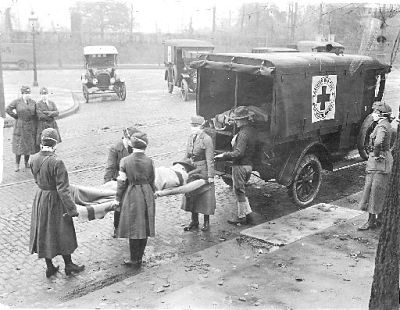
Spanish Flu – not

If I hear one more smug, well-dressed public health expert threaten us with the Next Great Pandemic, be it swine flu, avian flu or H1N1, with its inevitable comparison to the 1918 Spanish flu that “killed millions and millions”, the top of my head will blow off.

Presented in the metaphor of war, the virus is no longer a miniscule chunk of protein that requires a living, breathing body to reproduce but a rampaging army, mowing down everything in its path. Conveniently forgotten is that just as important as the “strength” of the virus is the health and immuno-competence of the host. Which brings me to the Spanish flu.

First off, it wasn’t “Spanish” – viruses not being good with national borders (plus most of them don’t have passports). The flu began somewhere in Europe at the end of a long and bloody war which you might recall: World War I.

The Allies, however (us, I mean, aka the Good Guys fighting the “Hun” and keeping the world safe for capitalism and democracy and whatnot) heavily censored news of the flu, thinking it would cause panic and pandemonium. (As if the war hadn’t already done that.)  So news of the flu trickled in from Spain, neutral during the war, which did not censor its news. Hence, people assumed the flu came from Spain.

Generally speaking, 1918 was not a good year, coming as it did after four years marked by new weapons and a war machine the likes of which the world had not seen before  – which is why WWI was also known as “the war to end all wars”. Millions of of young men died: cannon fodder for tactics devised by generals schooled in the gentlemanly art of 19th century war in what became known as the start of the 20th century in all its technological splendour.

Faded sepia photographs are all we have left of the many who died; dressed in those ugly boiled wool uniforms that make you itch just looking at them. Boys, really, living and dying in muddy trenches: damp, mouldy underground passages where micro-organisms proliferated as did gangrene and fungus and rot. And if anyone objected they were shot as a traitor.

I don’t tend to get sentimental about war but I confess that I wept when I saw the monument at Vimy. (“Every day they die among us,” said Auden, “those who were doing us some good.”) An entire generation lost to trench warfare.

That was the context for the Spanish flu: war, rationing, weakened immune systems, shell shock, malnutrition; the constant noise of cannons, stress, and injuries too horrible to contemplate; amputees in the hundreds of thousands. As ugly a situation as it gets. And no social programs, remember – those came much later, after the next great war. Everyone suffered, not just the military.

Medicine had little to offer: no antibiotics, no ventilators, no ICU’s, no potentially life-saving surgeries. Had there been, fewer people might have died (since it is the immune reaction that kills, not the virus), though we have no way of knowing – any more than we know how many people actually died of the “Spanish” flu.

(I suspect a fair amount of  hyperbole has crept into the numbers – particularly given the sheer number of agencies, drug companies and individuals that currently stand to gain in power and prestige from the scare tactics, not to mention funding and/or profit.)

Certainly in 1918 there was no way of testing for the virus, and even today, when we can (if we do), easily half the people diagnosed with the flu turn out not to have it. Experts call it “flu like” illness because they have no idea what it is. People just get sick when the weather gets cold, some worse than others.

So you’ll forgive me if I don’t get into a lather every time this pandemic business comes up with its inevitable reference  to 1918. Today, conditions for the majority of us in the developed world are so different as to make such comparisons  meaningless. Epidemiology shows us that the risk of getting any disease is higher if one is poor, malnourished, stressed, immune compromised; if one does not have ready access to clean water and air, nutritious food and decent  living conditions, jobs and hope. This means some Aboriginal reserves  in Canada and various pockets of poverty  throughout the United States, Europe and Japan, as well as most of the developing world.

Not the rest of us for whom hardship means our internet is down.

It wasn’t really a vaccine and a multi-million dollar PR campaign we needed last fall. Particularly since the massive expense will no doubt mean future cuts in less glamorous public health programs like suicide prevention for at- risk youth and the like. What we really needed were clear-eyed, long-term initiatives to fundamentally ameliorate the conditions of those communities on our own doorstep where people live impoverished, hopeless lives, in circumstances somewhat more similar to those of 1918.

There’s a public health program I would support. But, I doubt anybody would be interested. It wouldn’t make good TV.